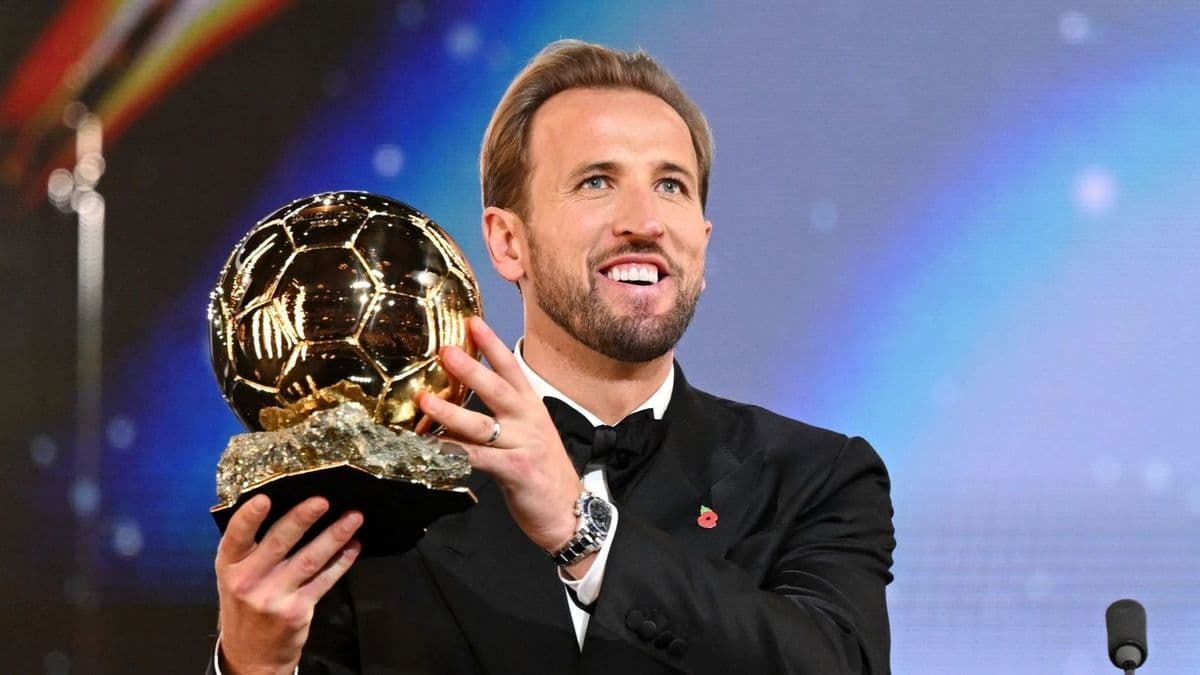

England and Bayern Munich footballer Harry Kane has won the 2026 Ballon d’Or, the prestigious individual award presented by France Football in collaboration with UEFA. The ceremony, held at the London Palladium in London on 26 October 2026, marked the 70th anniversary of the award, which recognises outstanding performances in both men's and women's football.
Kane won the German Bundesliga title with Bayern Munich for the second consecutive season. He also helped England finish third at the 2026 FIFA World Cup, hosted by the United States, Mexico and Canada, the country's best World Cup result since winning the tournament in 1966.
Early Career at Tottenham
Kane's rise to prominence began at Tottenham Hotspur, where he established himself as one of the most prolific strikers in the Premier League. He came close to winning the league title in 2015/16, when Tottenham finished third behind champions Leicester City and Arsenal. Leicester's triumph was particularly notable given that the club had been promoted from the Championship in 2014.
Despite his individual brilliance and impressive goalscoring record, major team trophies remained elusive in England. He won the Premier League Golden Boot three times, in 2015/16, 2016/17 and 2020/21, but Tottenham failed to secure the league title during his spell.
He also came close to a major trophy in the 2018/19 UEFA Champions League campaign. Tottenham reached the final for the first time in its history but lost 2-0 to Liverpool on 1 June 2019.
Move to Bayern Munich
Despite these disappointments, Kane continued to perform at a high level, eventually earning a move to Bayern Munich in August 2023 in search of major trophies.
However, his first season did not go as planned. The club, which had won 11 consecutive Bundesliga titles before Bayer Leverkusen ended that run in 2023/24, finished third. Kane nevertheless enjoyed an outstanding individual campaign, scoring 36 Bundesliga goals to win the top-scorer award.
In the following season, Kane achieved a major team success. Bayern were crowned Bundesliga champions in 2024/25, securing the club's 34th German top-flight title. Kane, then 31, had finally won the first major team trophy of his senior career. He scored 26 league goals that season and won the top-scorer award for the second consecutive year.
His success continued in 2025/26, when Bayern retained the Bundesliga and won the DFB-Pokal, completing a domestic treble alongside the German Super Cup. Kane scored 73 goals for club and country across all competitions, including 61 for Bayern Munich and 12 for England.
Style of Play
Beyond his goalscoring ability, many fans and observers have admired Kane's overall style of play. He is known for his mentality on and off the pitch and his ability to contribute beyond scoring. His game combines finishing, vision, short and long passing, and the ability to drop deep to create opportunities for teammates, establishing him as a complete forward rather than simply a traditional striker.
Kane also once played as a goalkeeper during his youth football days, an unusual experience that has occasionally attracted attention.
The Significance of the Award
Winning the Ballon d'Or in 2026 has further recognised Kane's individual excellence and his contribution to Bayern's success. His achievement is particularly significant because his career had long been associated with outstanding individual statistics but an absence of major team trophies. His move to Germany provided the opportunity to turn those performances into collective success.
For many observers, his achievements in Germany strengthened his Ballon d'Or credentials. The award considers individual performances, contributions to team success and overall impact. Although winning trophies does not automatically guarantee the award, Kane's goalscoring record and contribution to Bayern's domestic achievements provided a compelling case.
In his acceptance speech, Kane expressed gratitude to those who had supported him throughout his career, including Tottenham Hotspur, where he developed into a world-class striker. His acknowledgement was a reminder that, despite leaving without a major senior team trophy there, Tottenham played a significant role in shaping his career.
An English Milestone
Kane's victory ended a 25-year wait for an English winner of the men's Ballon d'Or. He became the fifth Englishman to receive the award, following Sir Stanley Matthews in 1956, Sir Bobby Charlton in 1966, Kevin Keegan in 1978 and 1979, and Michael Owen in 2001.
He finished ahead of Kylian Mbappé of Real Madrid and Lamine Yamal of Barcelona, who occupied second and third place respectively. Both players are younger than Kane and have attracted considerable attention for their performances and potential. Nevertheless, Kane's victory demonstrated that sustained excellence, goalscoring consistency and contributions to team success can remain decisive.
For some observers, his triumph brought a refreshing dimension to the award, which has often been closely associated with players who combine individual brilliance with major team achievements. His journey from years of near misses in England to domestic success in Germany and ultimately the Ballon d'Or is a reminder of how persistence can reshape a career.
Broader Context
The Ballon d'Or has historically been dominated by European and South American footballers, with Africa having only one winner. Liberia's George Weah, who played for AC Milan, remains the only African footballer to have won the honour, claiming it in 1995. However, several African players have come close, particularly Samuel Eto'o of Cameroon during his time at Barcelona. Eto'o scored 152 goals in 234 appearances for the Spanish club between 2004 and 2009, winning two Champions League titles and three La Liga championships. His 2005/06 season was particularly outstanding, as he scored 34 goals in all competitions, including 26 league goals, while helping Barcelona retain their domestic title and win the Champions League. Despite these achievements, he never won the Ballon d'Or, finishing fifth in 2009.
Another notable example is Egypt's Mohamed Salah, who enjoyed an extraordinary debut season at Liverpool in 2017/18, scoring 44 goals in 52 appearances, including 32 Premier League goals. He helped Liverpool reach the Champions League final, although they lost to Real Madrid. The following season, Salah scored 27 goals and helped Liverpool win the Champions League, scoring in the final against Tottenham Hotspur. He also finished joint-top scorer in the Premier League with 22 goals. Despite these achievements, he did not win the Ballon d'Or in either season.
Beyond performances on the pitch, the award has also generated conversations about the influence of popularity, public relations, global visibility and a player's overall profile. Footballers have increasingly needed to build their public profiles, particularly in an era where social media following and commercial appeal have become significant parts of the modern game. However, Kane's victory has brought renewed attention to the argument that footballing merit should remain at the heart of the highest individual accolade, an honest combination of individual excellence, consistency and contribution to collective success.
Harry Kane has now achieved what many once considered beyond his reach. After years of scoring goals without lifting a major senior team trophy, he has established himself as a Bundesliga champion and the 2026 Ballon d'Or winner. His achievement represents not only a personal milestone but also recognition of the consistency, discipline and quality that have defined his career.