
The Production of Palm Oil in Nigeria and Its Historical Development
Long before crude oil transformed Nigeria’s economy, another “oil” quietly powered trade, livelihoods, and entire communities across the country. This was palm oil, an agricultural product that once made Nigeria the leading supplier of vegetable oil to the world.
Palm oil production has long been one of the most important agricultural activities in Nigeria. For centuries, the oil palm tree has played a central role in the economic, cultural, and social life of many communities, especially in the southern and southeastern parts of the country. Nigeria was once the world’s largest producer and exporter of palm oil, and the industry significantly shaped the country’s economy before the discovery of crude oil. Understanding how palm oil production started and evolved in Nigeria provides insight into the country’s agricultural history and economic transformation.
Origins of Palm Oil in Nigeria
Palm oil is extracted from the fruit of the oil palm tree, scientifically known as *Elaeis guineensis*. This plant is native to West and Central Africa and has been used by local communities for thousands of years. Evidence suggests that palm oil was used as far back as 5,000 years ago in West Africa, where it served as a staple food ingredient and an important trade commodity. Archaeological discoveries have even shown palm oil stored in ancient Egyptian tombs, demonstrating its early cultural and economic significance.
In Nigeria, oil palm trees grow naturally in the humid rainforest regions of the south. For many generations, rural communities harvested palm fruits from wild groves rather than cultivated plantations. The oil extracted from these fruits was used mainly for cooking, traditional medicine, and the production of soaps and cosmetics. In many areas, the oil palm tree became deeply integrated into local culture and daily life, symbolizing wealth, sustenance, and community identity.
Early Trade and Expansion
The large-scale production and trade of palm oil began during the nineteenth century. At that time, European countries were experiencing the Industrial Revolution and required vegetable oils for lubricating machines, making soap, and producing candles. Palm oil became a valuable commodity for international trade, especially for British merchants operating along the West African coast.
Nigeria’s southern coast was once referred to by European traders as the “Palm Oil Coast” because of the large quantities of palm oil exported from the region. By 1832, palm kernels from West Africa were already being exported in large quantities, and Nigeria accounted for a significant share of that trade. By 1911, British West Africa exported about 157,000 tonnes of palm oil and palm kernels, with roughly 75 percent coming from Nigeria.
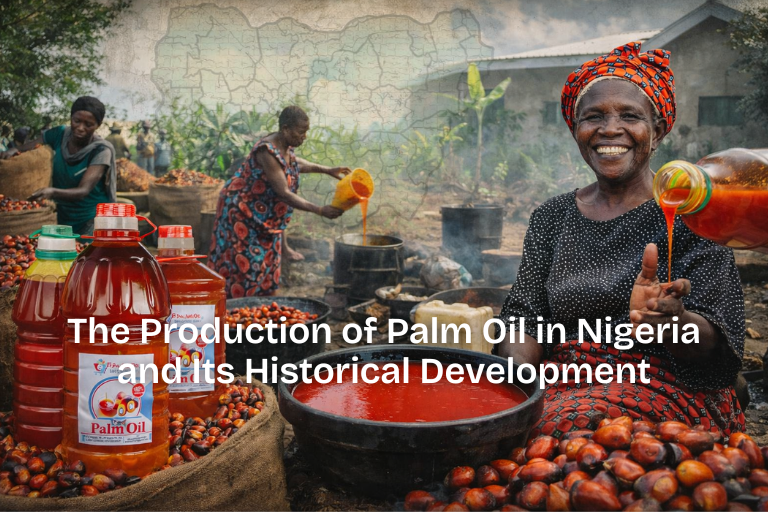
During this period, local farmers harvested palm fruits and processed them using traditional methods. The fruits were boiled and pounded to separate the oil from the pulp, after which the oil was collected and stored in containers for trade. Although the methods were labor-intensive, they allowed thousands of smallholder farmers to participate in the palm oil economy.
Colonial Influence and Institutional Development
During the colonial era, the British administration sought to increase palm oil production to meet global demand. To achieve this, the colonial government introduced new agricultural policies and established research institutions to improve the cultivation and processing of oil palm.
One of the major developments was the establishment of an oil palm research station in 1939, which later became the West African Institute for Oil Palm Research. The goal of this institution was to study improved palm varieties, increase yields, and promote better farming techniques among local farmers.
Despite these efforts, most palm oil production in Nigeria continued to rely on small-scale farmers and wild palm groves rather than large commercial plantations. This structure meant that the industry remained decentralized but widely accessible to rural communities.
Nigeria as a Global Leader
By the 1950s and early 1960s, Nigeria had become one of the world’s leading producers of palm oil. At that time, palm oil was a major export product and a key source of national revenue. In fact, Nigeria accounted for about 43 percent of global palm oil production during the early 1960s.
Palm oil production provided employment for millions of people in rural areas. It also supported local industries such as soap manufacturing, cosmetics production, and food processing. The industry was therefore a major contributor to Nigeria’s agricultural economy and helped sustain livelihoods across the southern regions of the country.
Decline of the Industry
Despite its early success, Nigeria’s dominance in palm oil production began to decline in the late 1960s. Several factors contributed to this change. One major factor was the discovery of crude oil in Nigeria, which shifted government attention and investment away from agriculture toward the petroleum sector. As a result, the palm oil industry received less support and modernization.
At the same time, countries such as Malaysia and Indonesia adopted more advanced plantation systems and improved processing technologies. These countries quickly expanded their palm oil industries and eventually surpassed Nigeria in global production.
Another challenge was Nigeria’s reliance on traditional processing methods and smallholder farming systems, which limited productivity compared to large-scale plantations in Southeast Asia.
Modern Palm Oil Production in Nigeria
Today, palm oil remains an important agricultural product in Nigeria, although the country is no longer the world leader in production. Most palm oil in Nigeria is still produced by smallholder farmers spread across millions of hectares of farmland. These farmers cultivate oil palm trees and process the fruits using a combination of traditional and modern techniques.
In recent years, both government and private investors have attempted to revive the industry through the development of commercial plantations and modern processing facilities. Companies such as large plantation operators now manage estates and produce crude palm oil for both domestic consumption and industrial use.
Palm oil production has a long and significant history in Nigeria. From its origins in ancient West African agriculture to its rise as a major export commodity during the colonial era, palm oil has played a crucial role in shaping Nigeria’s economic and cultural landscape. Although the industry declined after the discovery of petroleum and the rise of Asian producers, it remains a vital part of Nigeria’s agricultural sector. With renewed investment and improved farming practices, palm oil production continues to hold potential for economic growth and rural development in the country.