

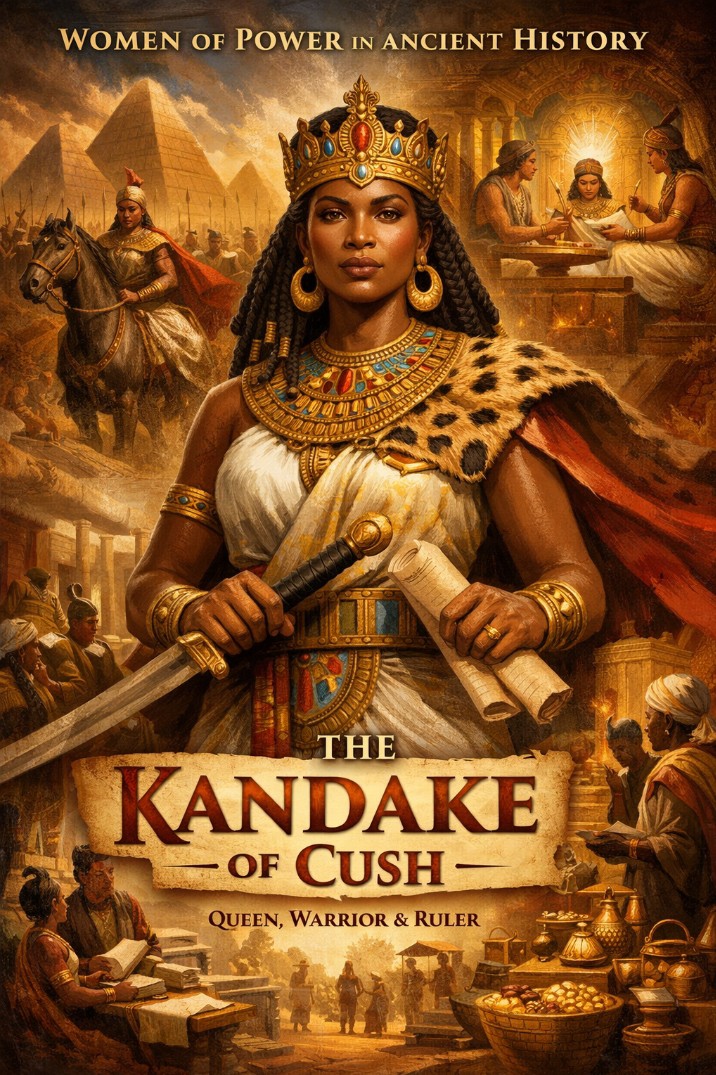
Women’s historical significance has never been confined to domestic spaces. Although the labour of sustaining families has always been vital to the health of society, the historical record shows that women also shaped politics, economies, religion, and war. Long before modern debates about gender equality, women in ancient societies were influencing governments, defending kingdoms, and helping determine the course of nations.
One of the clearest examples appears in the ancient Kingdom of Kush, where the Kandake rendered in some Greco-Roman sources as Candace stood as one of the most powerful figures in the state. Kush, located in what is now Sudan, flourished alongside ancient Egypt and later confronted Rome. Within this African kingdom, female authority was not merely informal or symbolic; it was recognized, structured, and embedded in governance.
The Kandake was not a decorative royal spouse standing behind a king. She was a political institution. Depending on the circumstances, the Kandake could rule alongside a king, serve as regent, or govern independently. She was involved in court administration, state decision-making, and the continuity of royal power. In Kush, female leadership was not treated as an anomaly. It was part of the system.
That distinction is important. In many ancient societies, women’s influence was often exercised indirectly: they advised kings in private, shaped succession behind the scenes, or influenced policy through family connections. In Kush, however, female power was official. The authority of the Kandake was visible in the public life of the kingdom, and her role carried genuine political weight.
The Kandake’s importance extended to matters of succession and legitimacy. In some cases, royal authority was closely tied to maternal lineage, which meant that the queen mother’s position was central to the stability of the state. Her role was therefore more than symbolic motherhood; it was institutional power rooted in the very structure of the kingdom.
Yet governance was only one dimension of her significance.
The Kandake also had military relevance. In the late first century BCE, the Kushite queen Amanirenas became famous for leading resistance against Roman expansion after Rome pushed southward from Egypt. Kush did not simply submit; it fought back. Amanirenas is remembered for leading her people in conflict and for helping secure a settlement that preserved Kushite interests. Few kingdoms negotiated with Rome from a position of strength. That a woman stood at the centre of such resistance makes her story especially remarkable.
This is not legend; it is history.
The Kandake also held religious authority. In the ancient world, political power and sacred legitimacy were deeply intertwined. Rulers were expected not only to govern but also to embody and protect the spiritual order of the state. The queen participated in rituals, temple life, and public ceremonies, reinforcing the connection between political stability and divine sanction. Her role in these sacred functions strengthened her legitimacy and the legitimacy of the kingdom itself.
Kush was also an economically significant power. It controlled important trade routes linking inner Africa to the Mediterranean world and was known for resources such as gold and iron. The administration of such a kingdom required careful oversight of trade, taxation, royal estates, and political relationships. The Kandake was part of that governing structure. She was not excluded from the management of wealth and resources; she was involved in the system that sustained the state.
What makes this history so important is not merely the fact that a woman once ruled. It is that Kush developed a political order in which female leadership was normalized. The authority of the Kandake was neither accidental nor rebellious. It was governance.
And Kush was not alone. Across the ancient world, women served as priestesses, regents, advisors, diplomats, and rulers. Their influence could be quiet or dramatic, private or public. Still, the Kandake stands out because her power was official, visible, and formidable. She reminds us that the historical record is more complex than the simplified story that men ruled while women merely observed.
This legacy offers several important lessons.
First, it reminds us that women have always participated in shaping society. Their contributions were not confined to the household, even when domestic labour itself was foundational to social stability. Women have influenced succession, negotiated peace, defended kingdoms, led religious life, and helped preserve national identity.
Second, the example of the Kandake shows that leadership and womanhood were not seen as incompatible. She did not rule in spite of being a woman; she ruled as a woman, drawing authority from political intelligence, royal status, and, in some cases, maternal lineage. Her leadership was not framed as weakness. It was recognized as power.
Third, this history challenges narrow ideas about what is truly “traditional.” If an ancient African kingdom could build recognized space for powerful women within its political structure centuries before modern democracies and long before women’s suffrage movements, then the claim that women’s leadership is a new or foreign idea becomes difficult to sustain.
The story of the Kandake therefore expands our understanding of both history and leadership. It demonstrates that female authority is not a modern invention but an ancient reality. Women have long stood in council chambers, on battlefields, in temples, and within systems of administration. They have not only sustained families; they have also helped sustain states.
To remember the Kandake is to remember that history has always been larger, richer, and more inclusive than simplified narratives allow. What many societies are debating today is not the creation of something entirely new. In many ways, it is the recovery of something very old.