
What if the answer to Africa’s housing crisis isn’t more cement, steel, and glass – but the very earth beneath our feet?
Across the continent, the demand for housing is rising rapidly. Cities are expanding, populations are growing, and the cost of building continues to climb. Yet, the dominant material (concrete) is increasingly proving to be part of the problem rather than the solution.
Concrete buildings are expensive. Cement prices fluctuate constantly, often driven by inflation, logistics, and import dependency. For many families, the cost of building even a modest home is becoming unrealistic. Beyond cost, concrete performs poorly in Africa’s climate. It absorbs and traps heat during the day, turning homes into ovens by afternoon. In places with unreliable electricity, this creates a dependency on fans or air conditioning that many cannot sustain.
There is also the environmental cost. Cement production is one of the largest contributors to global carbon emissions. As African countries continue to urbanise using concrete-heavy methods, they are unintentionally increasing their environmental burden while trying to solve a housing shortage.
And yet, despite these limitations, concrete remains the standard. Not because it is always the best option, but because of perception.
For decades, mud houses have been associated with poverty, rural living, and lack of progress. They are often seen as temporary structures rather than viable long-term homes. This perception has overshadowed an important truth: when properly designed and modernised, earth-based buildings can outperform conventional structures in several key areas.
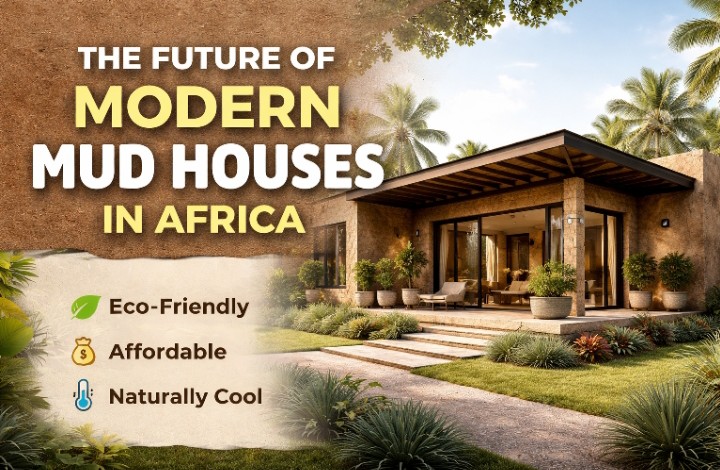
Modern mud construction is not about piling wet soil into walls. It has evolved into a refined system that combines traditional knowledge with engineering improvements. One of the most important innovations is the use of stabilised earth blocks – soil mixed with small amounts of cement or lime and compressed into uniform, durable units. These blocks are stronger, more resistant to water, and visually cleaner than traditional mud walls.
Beyond the material itself, design plays a critical role. Mud buildings naturally regulate temperature due to their thermal mass. They absorb heat during the day and release it gradually at night, keeping interiors cool when it is hottest outside. When combined with passive design strategies – such as cross ventilation, high ceilings, shaded verandas, and courtyard layouts – these homes can remain comfortable without relying heavily on electricity.
This is a significant advantage in regions where power supply is inconsistent or expensive.
Durability, often cited as a weakness, is largely a matter of construction quality. The biggest threat to mud structures is water, but this can be effectively managed. Raised foundations prevent moisture from seeping into walls. Wide roof overhangs protect surfaces from direct rainfall. Proper drainage systems ensure water does not accumulate around the building. External plastering with lime or cement adds an additional layer of protection.
When these measures are in place, earth buildings can last for decades with minimal structural issues.
Another major strength lies in cost and accessibility. Because the primary material (soil) is locally available, construction becomes significantly more affordable. This reduces reliance on imported materials and allows more people to participate in building their own homes. It also creates opportunities for local labour and skill development, keeping economic value within communities.
However, modernising mud housing is not without challenges. Maintenance is still required, particularly for exterior finishes exposed to harsh weather. Poorly executed construction can lead to cracks or erosion. There is also the persistent issue of social perception, especially in urban areas where concrete is seen as a symbol of status and permanence.
These challenges, however, are not insurmountable.
Maintenance can be reduced through the use of stabilised materials and protective finishes. Structural weaknesses can be addressed by integrating reinforced concrete elements such as columns and ring beams, allowing for more complex and durable designs. As for perception, it changes when the product changes. With clean finishes, modern roofing, glass windows, and thoughtful landscaping, earth homes can compete aesthetically with any conventional building.
At that point, the conversation shifts from “mud house” to “modern, energy-efficient home.”
Africa does not need to replicate building systems that were developed for entirely different climates and economic realities. It has the opportunity to adopt solutions that are locally suited, environmentally responsible, and economically viable.
Mud, when modernised, offers exactly that.
In a continent facing rising construction costs, energy challenges, and a growing housing deficit, building with earth is no longer a step backward. It is a practical step forward.