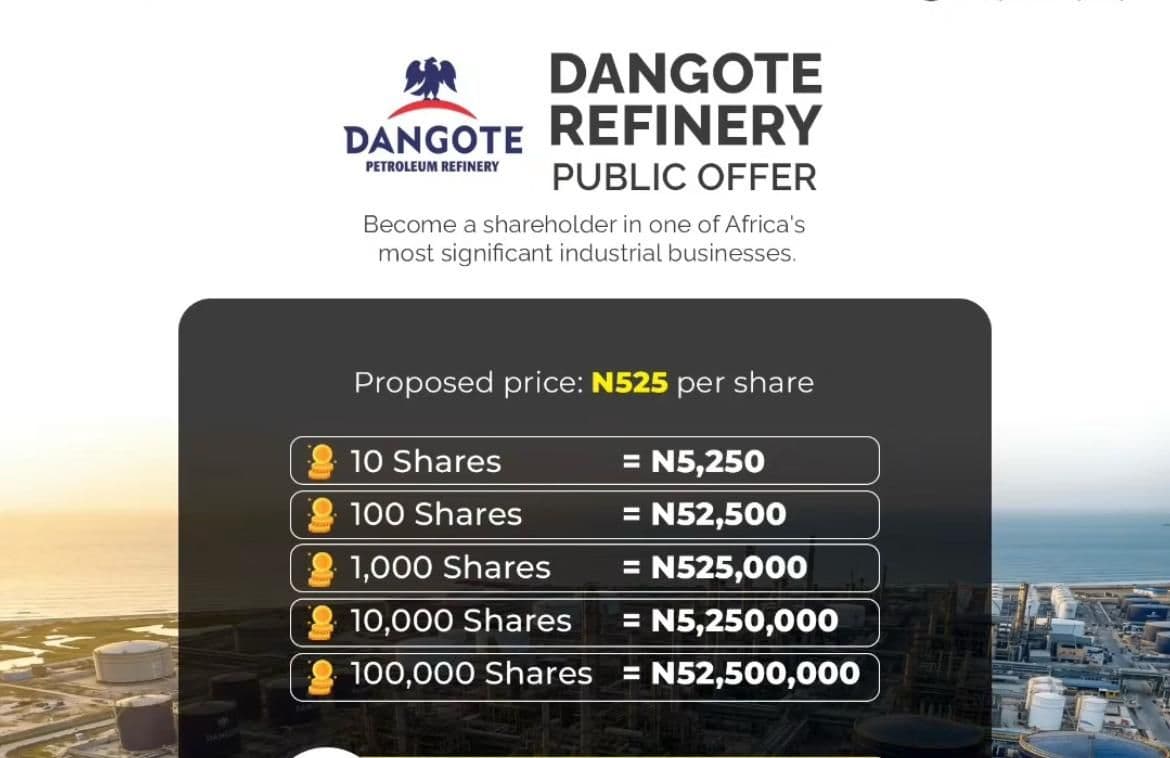

On Monday, 14 September 2026, the President and Chief Executive of Dangote Industries Limited, Aliko Dangote, sounded the gong on the trading floor of the Nigerian Exchange (NGX) in Lagos to mark the opening of the Dangote Refinery Initial Public Offering (IPO). The offer comprises 4.1 billion shares at ₦525 per share, with a minimum subscription of 10 shares, valued at ₦5,250, and is open to the public.
It is a significant moment for Nigeria, not least because of the attention it has generated.
Beyond the Elite
Ordinarily, opportunities of this scale are seen as the preserve of elites and those with privileged access to the business and financial sectors. This IPO deliberately breaks with that pattern. Open to retail, institutional and eligible African investors, it creates an opportunity for a much broader range of people to participate in the ownership of one of the country's most consequential businesses.
According to Dangote, the idea is about the "democratisation of wealth creation." The IPO, he said, is not simply about raising funds, but about opening a window for all Nigerians, irrespective of profession or class, to participate in the wealth of the company.
Why the Excitement Matters
Nigerians have responded with considerable excitement. For many, the offer brings within reach an investment opportunity that would previously have seemed distant. The petty trader in the market can now consider holding a stake in the same enterprise as an institutional investor.
That enthusiasm has been visible in the pressure on digital investment platforms and financial technology infrastructure, which have had to cope with unusually high levels of retail interest.
Stakeholders and financial advisers describe the move as significant for Nigeria's capital market, particularly for its potential to broaden participation in share ownership. Expected to raise about ₦2.15 trillion, it is set to be Africa's largest IPO by value.
More than Numbers
Beyond the figures and the frenzy, what makes this moment important is what it represents. For many people, investment has traditionally appeared distant, complicated or reserved for those with substantial resources. The Dangote Refinery IPO has brought that conversation much closer to the ordinary person.
The excitement, therefore, goes beyond buying shares. It speaks to a changing relationship between Nigerians and the capital market, where ownership of major businesses can become more accessible to a wider section of society.
Whether this moment will translate into a lasting culture of investment remains to be seen, but the conversation has already begun. The Dangote Refinery IPO may eventually be remembered not only for its size, but for the attention it has drawn to investment and wealth creation among ordinary Nigerians. If the effort to make investment more accessible can be sustained beyond this particular offer, it could mark more than another major transaction on the Nigerian Exchange. It could mark the beginning of a new chapter in how Nigerians see, understand and participate in investment.