

Artificial intelligence has become part of everyday life. From answering questions and generating images to helping businesses automate tasks, AI is changing how we work and communicate. But behind every prompt and response lies a physical infrastructure that many people never think about.
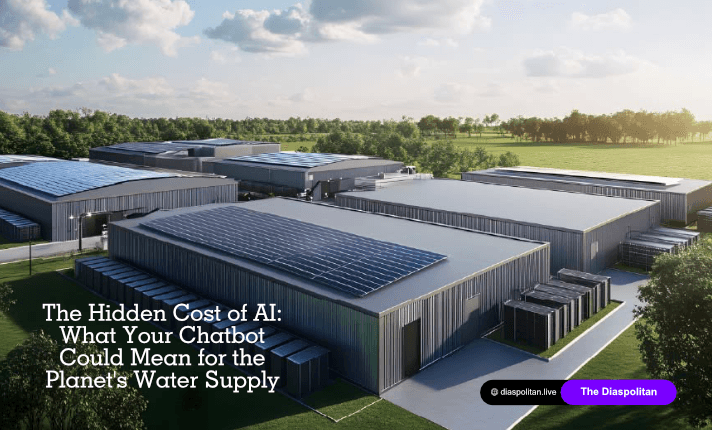
Every time you interact with an AI chatbot, your request is processed in a data center: a facility filled with thousands of powerful computers called servers. These servers perform billions of calculations every second to generate responses. While the process may seem instant, it requires significant computing power, and with that comes an often-overlooked challenge: heat.
As servers work continuously, they produce a large amount of heat, which, without effective cooling, could lead to overheating, reduced performance, and ultimately, damage. To prevent this, many data centers use advanced cooling systems, some of which rely on large amounts of water. Others use air or liquid cooling technologies, depending on their design and location. In other cases, water is used indirectly to generate the electricity that powers servers in regions where power plants depend on it. This has sparked growing discussions about AI’s environmental footprint.
The exact amount of water associated with AI is difficult to pin down. It varies depending on the type of AI model, the complexity of the request, the efficiency of the hardware, the cooling system, the climate, and the energy source powering the data center. For that reason, estimates differ, and researchers continue to study the issue. Still, one thing is becoming increasingly clear: as AI adoption grows, so does the need for more data centers and more computing power.
For some experts, this raises important questions. Could the rapid expansion of AI place additional pressure on water resources, especially in regions already experiencing drought or water shortages? As demand for AI services increases, some worry that the resource use could become a larger environmental concern if growth outpaces improvements in efficiency.
However, some argue that the picture is more complex. Data centers aren’t the only industry that consumes water. Agriculture, manufacturing, and energy production also consume massive amounts of water. They also point out that AI has the potential to improve water management, optimize energy use, accelerate scientific research, and make industries more efficient: benefits that could help offset some of its environmental costs.
The conversation extends beyond water. Running large AI systems also requires enormous amounts of electricity. Depending on how that electricity is generated, AI's carbon footprint can vary significantly. In response, many technology companies are investing in renewable energy, more efficient computer chips, and cooling systems designed to reduce water consumption. Some have also announced water conservation and replenishment initiatives aimed at balancing part of their environmental impact. Whether these efforts will be enough remains a topic of discussion. Some believe innovation will make AI increasingly sustainable over time, while others argue that greater transparency and stronger environmental standards will be necessary as demand continues to grow. For everyday users, this doesn't necessarily mean avoiding AI. Instead, it serves as a reminder that even digital technologies rely on real-world resources. Just as streaming videos, storing files in the cloud, and charging electric vehicles have environmental footprints, and AI is no exception. Artificial intelligence has the potential to transform healthcare, education, business, and scientific discovery in remarkable ways. At the same time, it invites important conversations about how society balances innovation with responsible resource use.
Rather than viewing AI as either entirely beneficial or entirely harmful, it may be more useful to recognize that its impact depends on how it is developed, powered, and managed. As the technology continues to evolve, so too will the discussions surrounding its environmental costs, including the water that helps keep the digital world running.