
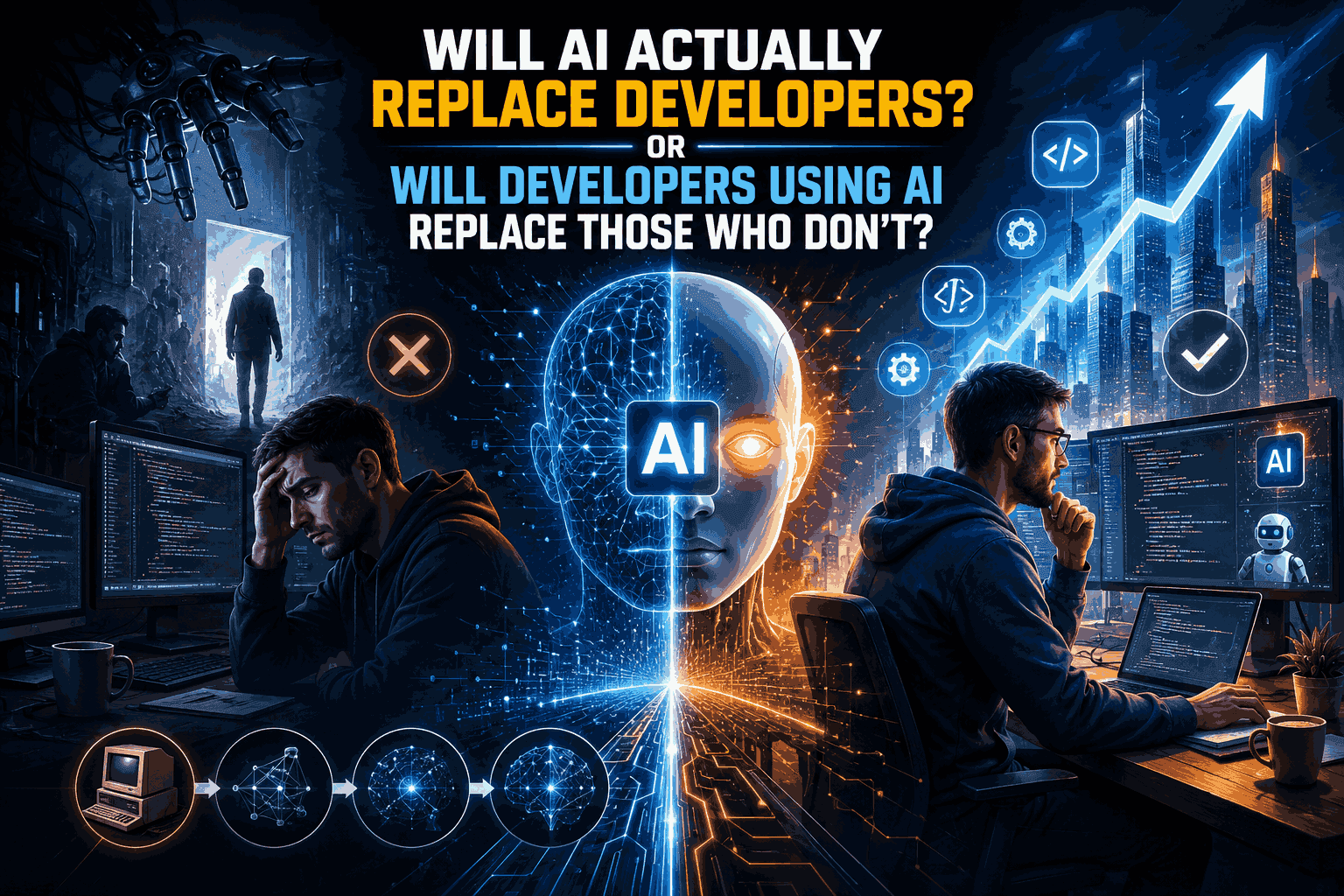

Artificial Intelligence is reshaping software engineering. From healthcare to finance to education, AI-powered coding assistants can now write code, debug errors, and explain complex systems in seconds.
That has sparked a blunt question in tech circles: will AI replace developers entirely, or will developers who use AI simply replace those who don’t?
The answer is not binary. AI is not erasing programming. It is changing it. The routine is being automated. The work that requires judgement, creativity and context is becoming more valuable.
From Turing to Copilot: A Brief History
The idea of machine intelligence is not new. It dates back to the mid-20th century. In 1950, British mathematician Alan Turing published Computing Machinery and Intelligence, proposing what became known as the Turing Test. The term “Artificial Intelligence” was coined in 1956 at the Dartmouth Summer Research Project, led by American computer scientist John McCarthy, widely regarded as the “Father of AI."
From rule-based systems, AI has evolved into machine learning and deep learning models that can generate content, analyse data and assist with complex decisions. Today’s coding assistants are built on decades of research in computer science, mathematics, neuroscience and statistics.
Where AI Helps Most
The biggest impact of AI in development so far is productivity.
Modern assistants can generate code snippets, detect bugs, suggest improvements, write documentation, automate tests, explain unfamiliar code, and translate between programming languages. That frees developers to focus on architecture, design and solving business problems.
For beginners, AI accelerates learning with instant examples and explanations. For experienced engineers, it shortens development cycles and improves code quality.
For companies, AI-assisted workflows can cut costs, speed up delivery, and improve competitiveness in a digital-first economy.
Where AI Falls Short
The gains come with limits.
AI-generated code is not always accurate, secure or efficient. Accepted without review, it can introduce subtle bugs or vulnerabilities. Overreliance is a risk too, especially for beginners who copy solutions without understanding the logic behind them.
AI also lacks human creativity, empathy, ethical judgement and deep business context. In sensitive domains like privacy, cybersecurity, healthcare, finance and national security, human oversight remains non-negotiable.
There are further concerns around intellectual property, data privacy and the responsible use of AI-generated content.
The Future Is Collaborative
The trajectory points to partnership, not replacement.
Developers are shifting from writing every line manually to supervising AI output, validating it, refining architecture, and making strategic decisions.
As AI matures, new roles are emerging: AI engineering, prompt engineering, machine learning, AI ethics, cybersecurity, cloud and intelligent automation. Organisations will increasingly value people who combine programming fundamentals with the ability to integrate AI into daily work.
History offers a guide. Calculators did not replace mathematicians. Design software did not replace graphic designers. AI is likely to redefine software development in the same way: by changing the tools, not eliminating the craft.
So, Who Is At Risk?
Current trends suggest AI will not replace skilled developers. But developers who embrace AI will outperform those who resist it.
Businesses want speed, quality and efficiency. Professionals who pair technical expertise with AI-assisted workflows will have the advantage. The developers most at risk are not those competing with AI, but those unwilling to learn how to work with it.
Conclusion
AI is not the end of software development. It is the start of a new era where human intelligence and artificial intelligence work together. AI can automate repetition and improve efficiency. It cannot replicate human creativity, leadership, ethical reasoning, or the ability to understand complex human needs.
The future belongs to developers who embrace lifelong learning and treat AI as a collaborator. In that sense, AI may not replace developers. But developers who use AI are likely to replace those who don’t.
Key Points
Advantages of AI
· Accelerates development and coding productivity
· Automates repetitive tasks such as testing and debugging
· Helps developers learn new languages and frameworks
· Improves code quality through intelligent suggestions
· Reduces costs and time to delivery
· Enhances collaboration with automated documentation
Disadvantages of AI
· Can produce inaccurate, insecure or inefficient code
· Risks overreliance and weaker critical thinking
· Lacks creativity, empathy and ethical reasoning
· Raises concerns about privacy, copyright and data security
· Still requires human review for reliability and compliance
Future Outlook
· Greater collaboration between humans and intelligent systems
· Faster innovation across industries
· Rising demand for AI-skilled developers and engineers
· More accessible software development for beginners
· Growth in careers across AI, ML, robotics, cybersecurity and intelligent automation