

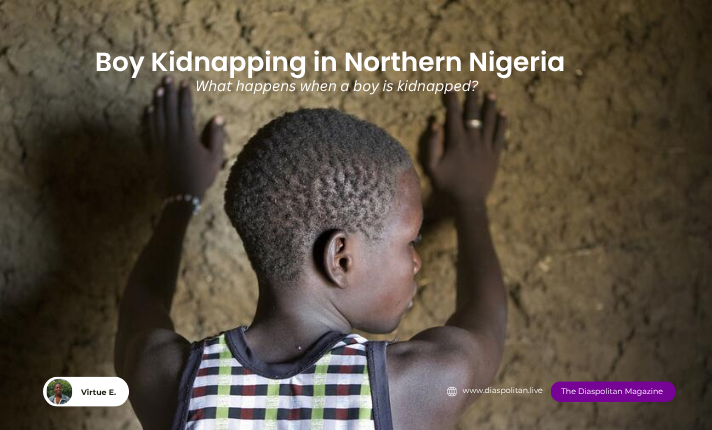
When girls are kidnapped, the risks are often named: sexual violence, forced marriages, trafficking and forced childbearing. But what happens when a boy is kidnapped? Is he subjected to abuse, sold into slavery or forced into labour?
These are urgent questions in light of Nigeria’s ongoing debate about the rehabilitation and reintegration of former Boko Haram members.
A Pattern of Abductions
In December 2020, 344 boys were abducted from Government Science Secondary School in Kankara, Katsina State. They were held for six days before being released. What occurred during those days remains largely undocumented.
In February 2021, 27 students were abducted from Government Science College Kagara, Niger State, along with three staff members and 12 relatives. One student was killed during the attack. The rest were released.
Not every case ends this way.
In December 2014, Boko Haram abducted about 40 boys and young men aged between 12 and 25 from Malari, Borno State. Twenty-eight were later released, but at the time Amnesty International documented the incident, the whereabouts of 12 remained unknown.
Weeks earlier, Boko Haram besieged the border town of Damasak in Borno State and took over Zanna Mobarti Primary School. More than 300 children aged between 7 and 17 were caught in the assault. When the group withdrew in March 2015, they took children with them. According to Human Rights Watch, the fate of many of those children remains unknown.
Life Inside Captivity
These cases point to a question that receives considerably less attention than the abduction of girls: what happens to boys after they disappear?
Are they subjected to forced labour, domestic work, physical abuse or indoctrination? The answer is not straightforward. An abducted boy can be used as a messenger, porter or guard. In the context of armed groups, he may be forced to carry weapons or participate in violence.
A boy abducted at 12 loses his freedom, the love of his family, and his schooling. His environment changes. His captors become his teachers and his primary reference point. Over time, he may be coerced into the very activities that led to his abduction.
If he returns years later, does he come back as the child who was taken or as the person captivity made him?
Rehabilitation and the Problem of Reintegration
This question sits uncomfortably alongside Nigeria’s programmes to rehabilitate and reintegrate former Boko Haram members.
Opposition to these programmes is understandable. Boko Haram has killed civilians, destroyed communities, crippled local economies and abducted thousands of people. For families affected by the insurgency, the idea of perpetrators receiving vocational training and a path back into society is deeply painful.
There are also legitimate questions about sincerity. It is difficult to determine whether someone who surrenders has genuinely abandoned the group’s ideology, or whether they intend to remain part of it.
Crucially, the histories of former members are not identical. Some may have joined voluntarily, motivated by ideology or economic desperation. Others may have been coerced. Some may have been abducted as children, raised within the group, and taught its ideology as the only reality they knew. These distinctions matter for justice, for policy, and for communities asked to receive them back.
Consider the difference between a 30-year-old man who joins an insurgency voluntarily and a 13-year-old boy who is abducted and indoctrinated for seven years. If both surrender, should their cases be treated in the same way?
What of the reverse: if a person was once a victim and later participates in violence against other victims, does that earlier victimhood absolve the harm they caused? There is no easy answer.
After the Release
Nigeria’s kidnapping crisis has produced thousands of victims, but the story does not always end at release. Some return home. Some remain missing. Others return changed.
Perhaps the most uncomfortable question is not simply what happens when boys are abducted.
Perhaps it is what happens afterwards: when the abducted boy returns as someone society no longer recognises.