
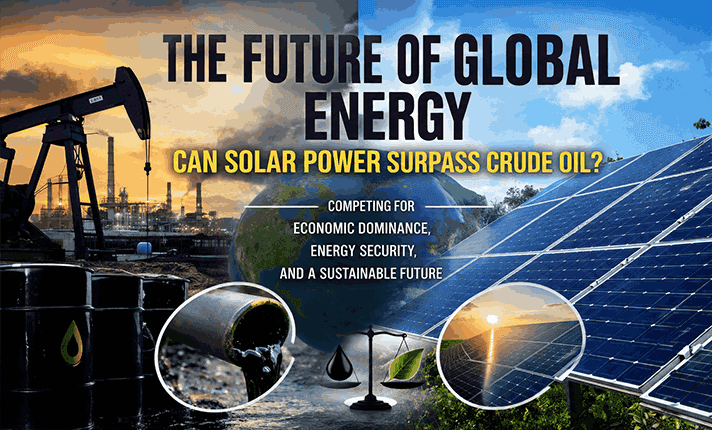

For more than a century, crude oil has been the foundation of the global economy. It has driven industrial growth, transportation, manufacturing and international trade. Since the first large commercial reserves were discovered in Pennsylvania in 1859, and later in places like Baku, the Middle East and Oloibiri in Bayelsa State, Nigeria, in 1956, petroleum has transformed nations and supplied energy for billions.
Today, major producers include Saudi Arabia, the United States and Nigeria, while large consumers include China, India and Germany. Yet concerns over climate change, emissions, energy security and the finite nature of fossil fuels have accelerated the search for cleaner alternatives. At the forefront is solar power, one of the fastest-growing renewable sources. The question facing governments, industries and scientists is no longer whether solar has a role, but whether it can eventually rival or even surpass crude oil as the dominant force in the global energy economy.
The Rapid Rise of Solar
Solar power converts sunlight directly into electricity through photovoltaic panels or harnesses solar heat through concentrated systems. Unlike crude oil, it is renewable, produces little to no direct greenhouse gas emissions during operation, and relies on an energy source that reaches every continent.
Advances in the past two decades have reduced costs and improved efficiency. China is now the world’s largest manufacturer of panels, while countries including Germany, the United States, Morocco and India have invested heavily in large-scale farms and rooftop installations. Africa is also making progress. Nations such as South Africa, Kenya, Egypt and Nigeria are expanding solar projects to improve access in underserved communities.
Research by international energy agencies consistently shows that solar and wind are becoming increasingly cost-competitive with fossil fuels, especially where sunlight is abundant and long-term operating costs are considered.
Why Oil Still Holds Ground
Despite this growth, crude oil retains advantages that solar has not fully replaced. Petroleum remains indispensable for aviation fuel, maritime transport and petrochemicals. It is the feedstock for plastics, pharmaceuticals, fertilisers and lubricants that cannot yet rely solely on solar electricity.
Oil also offers high energy density. It can be stored and transported relatively easily through pipelines, tankers and storage facilities. Solar, by contrast, depends on weather and daylight. Reliable storage remains a major challenge. Battery technology has advanced considerably, improving grid stability, but large-scale storage is still expensive and technically demanding.
Producing panels also requires critical minerals such as lithium, cobalt and silicon. This creates new environmental and geopolitical pressures around mining and supply chains. Replacing every function currently performed by crude oil therefore remains a complex scientific, economic and technological task.
Opportunities and Challenges for Oil-Producing Nations
The energy transition presents both opportunity and challenge. For countries such as Saudi Arabia, Norway, Nigeria and Angola that derive significant revenue from petroleum exports, economic diversification is becoming more urgent. For countries investing aggressively in renewables, such as China, Germany and the United States, the shift is creating new industries, attracting investment and reducing dependence on imported fossil fuels.
For Nigeria and many African nations, solar offers enormous potential. Sunlight is abundant, particularly across the northern regions where irradiation is among the highest in the world. Expanding solar could improve electricity access for rural communities, support health facilities, strengthen agricultural productivity through solar irrigation, and stimulate local manufacturing.
Obstacles remain. Inadequate infrastructure, limited financing, inconsistent energy policies and a shortage of skilled technicians capable of installing and maintaining modern systems continue to slow progress.
Environmental Costs and Benefits
From an environmental perspective, the shift toward solar offers significant benefits. The combustion of crude oil contributes substantially to carbon dioxide and other greenhouse gases, which scientific evidence identifies as major drivers of global warming. Rising temperatures have already been linked to more frequent heatwaves, droughts, severe storms and rising sea levels.
Expanding renewables can help reduce these emissions while improving air quality and lowering pollution-related health risks. Solar is not without impact, however. Manufacturing, transportation and disposal of panels require careful management to prevent electronic waste and excessive resource extraction. Experts therefore emphasise the need for recycling technologies, sustainable mining and circular manufacturing that minimise environmental footprints across the life cycle of these technologies.
A Diversified Future, Not a Simple Replacement
The future of global energy is unlikely to be defined by a simple replacement of crude oil with solar. It will be a gradual move toward a more diversified and sustainable system. Organisations including the International Energy Agency and the Intergovernmental Panel on Climate Change project continued growth in renewables, while recognising that oil and gas will continue to play important roles in sectors that remain difficult to electrify.
How fast that transition happens will depend on investment in storage, smart grids, hydrogen, carbon capture and continued innovation.
For Nigeria, the challenge is not choosing between crude oil and solar. It is using today’s petroleum resources responsibly to finance tomorrow’s clean energy economy. The future belongs to nations that balance economic development, environmental protection, technological innovation and energy security. Rather than competing in isolation, crude oil and solar are likely to coexist through the transition, with renewable energy steadily assuming a larger role as technology advances and the world moves toward a cleaner, more resilient and sustainable future.