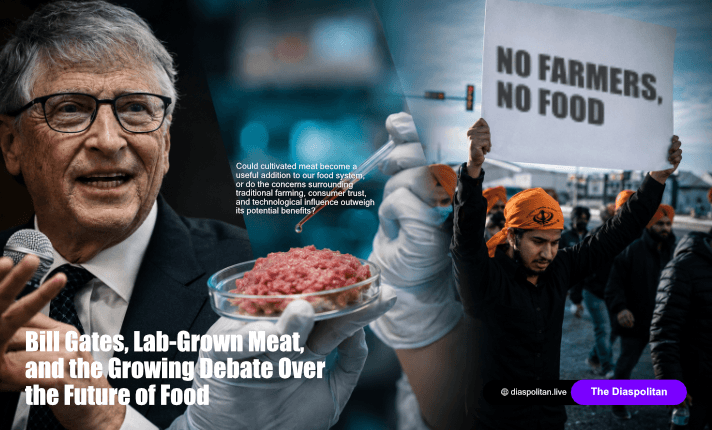

For years, Bill Gates has been one of the most influential voices advocating for technological solutions to global challenges. From clean energy and public health to agriculture and food production, the Microsoft co-founder has invested billions into innovations he believes could help address climate change and feed a growing population. Among those investments is cultivated or "lab-grown" meat. It’s a technology that has sparked one of the most polarizing debates in modern agriculture.
To supporters, cultivated meat represents a scientific breakthrough that could reduce greenhouse gas emissions, lessen pressure on land and water resources, and provide another way to produce protein. To critics, however, it symbolizes something much larger: a shift away from traditional farming toward a food system increasingly influenced by powerful investors, biotechnology companies, and government policy. This fight is not really about meat. It is about who controls food.
Bill Gates has openly supported alternative proteins and has invested in companies developing plant-based and cultivated meat technologies. In his public statements, he has argued that wealthier nations should consider reducing reliance on conventional beef because of its environmental impact, suggesting that alternative proteins could become part of the solution to climate change. His comments have earned praise from environmental advocates, but they have also attracted criticism from farming groups and others who question whether technology should replace or even significantly reduce traditional livestock agriculture. For some, Gates represents innovation. For others, he has become a symbol of growing corporate influence over essential parts of everyday life, including what people eat. Across Europe, farmers have staged major protests over the past few years. The demonstrations have largely focused on rising production costs, environmental regulations, taxation, imports, and concerns about the long-term viability of farming.
Within those broader debates, cultivated meat has emerged as another point of concern for some farmers. They worry that increasing investment in alternative proteins could eventually reduce demand for conventionally produced meat or shift government funding away from traditional agriculture. Many livestock producers also argue that farming is more than an industry. It is a way of life passed down through generations. From their perspective, replacing conventional meat with laboratory-produced alternatives could have significant cultural and economic consequences for rural communities. At the same time, it is important to note that the recent farmer protests have been driven by multiple issues. While cultivated meat has become part of the discussion in some circles, it is not generally regarded as the sole or primary cause of the demonstrations.
Public opinion on cultivated meat remains divided. One of the most common concerns raised by critics is nutrition. Some believe lab-grown meat may lack the nutritional value of conventionally raised meat or could be more heavily processed. Others question whether scientists fully understand its long-term health effects.
Researchers and companies developing cultivated meat, however, argue that its nutritional profile can be designed to resemble, or in some cases improve upon traditional meat by adjusting fats, proteins, vitamins, and minerals during production. Because the technology is still relatively new, research and regulatory evaluation continue, and many questions remain under active study. Another concern centers on consumer trust. Many people are hesitant to eat cultivated meat, citing concerns about unfamiliar production methods, food processing, labeling, and transparency. Even the phrase "lab-grown" itself evokes caution.
The debate has also reached lawmakers. Several U.S. states have enacted laws restricting or banning the sale of cultivated meat. Supporters of these measures argue they are protecting traditional agriculture, food transparency, and consumer confidence. Others see the bans as a precaution while the technology continues to develop. Critics of the bans, however, argue that governments should allow consumers to choose for themselves and that innovation should not be blocked before the market has had an opportunity to mature. The differing approaches illustrate how governments are grappling with questions that extend beyond science, touching on economics, ethics, consumer rights, and agricultural policy.
Another recurring source of controversy involves Bill Gates' comments about population growth. Over the years, clips from a 2010 TED Talk have circulated widely online. In that talk, Gates discussed how improvements in healthcare, vaccination, education, and economic development are historically associated with lower birth rates over time. Demographers have long observed this relationship in many countries. However, excerpts from the talk have often been shared without their full context, leading some people to interpret his comments as support for deliberate population reduction. Gates has consistently said he was referring to voluntary demographic trends linked to improved public health rather than coercive population control.
Even so, skepticism remains among some members of the public, particularly those who are wary of the influence wealthy philanthropists and global institutions can have on public policy.
Perhaps the biggest issue is not cultivated meat itself, but trust. Supporters believe technology can help solve some of humanity's most pressing problems, from climate change to food security. Critics argue that innovation should not come at the expense of local farmers, consumer choice, or democratic oversight. The debate also reflects broader questions about who shapes the future of food. Should governments encourage new technologies to address environmental challenges? Should private investors play such a prominent role in influencing agricultural innovation? How should society balance scientific progress with preserving traditional industries and ways of life? These are complex questions with no simple answers.
Cultivated meat is still in its early stages, and its future remains uncertain. Whether it becomes a mainstream food source, remains a niche product, or develops alongside conventional agriculture will depend on scientific progress, consumer acceptance, market forces, and government policy.
This conversation touches on climate change, economics, ethics, public trust, and the role of technology in shaping everyday life. As the debate continues, people from all sides will likely continue asking difficult questions about innovation, regulation, and the future of farming. What do you think? Could cultivated meat become a useful addition to our food system, or do the concerns surrounding traditional farming, consumer trust, and technological influence outweigh its potential benefits?