
Imagine waking up this morning to discover there’s no electricity. Your phone is dead, the Wi-Fi is off, and the refrigerator has gone silent. Everyone eventually discovers how dependent they are on electricity when their morning routine gets altered because their power supply is interrupted.
It’s easy to forget that modern life runs on energy. Every text message, every hospital, every factory, every traffic light and every football match under floodlights depends on a steady supply of power. Yet as the world’s population grows and technology gets more woven into our daily lives, one question keeps finding its way into conversations: can renewable energy power the world?
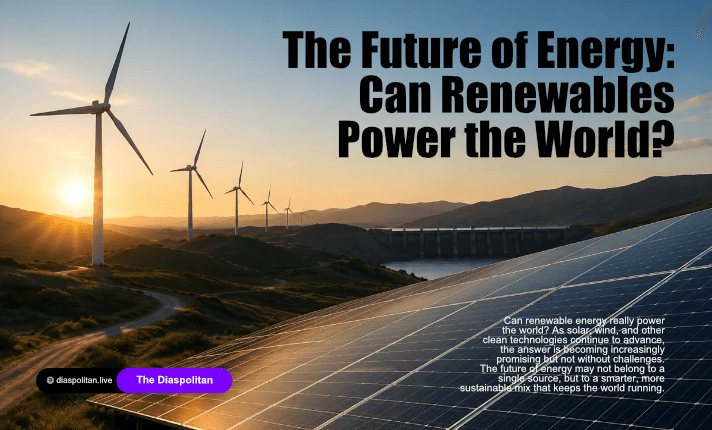
It’s a simple question. But the answer isn’t a simple yes or no. When people think of renewable energy, solar panels and wind turbines are the first to come to mind. Though they are the stars of the conversation, they aren’t alone. Hydroelectric power, geothermal energy, and tidal energy play a role in generating electricity without relying on fossil fuels. The appeal is obvious.
Unlike coal or oil, sunlight and wind are resources that we can’t run out of. As technology improves, costs come down. And as costs come down, governments, businesses, and homeowners get more interested in renewables. Environmentalists see renewable energy as an important factor that reduces greenhouse gas emissions and addresses climate change. While the exact mix of solutions is still debated, cleaner sources of electricity are one piece of a much larger puzzle.
The truth is, renewable energy isn’t a switch one can flip overnight. And one of its biggest challenges is consistency. The sun rises and sets, and the wind doesn’t keep office hours. Some days, renewable sources produce more electricity than is needed, and on other days, they produce much less. This means storage is important. Which brings us to battery technology. Batteries have improved in recent years, but experts still say large-scale energy storage is one of the biggest challenges in building a fully renewable electricity system. Think of it as trying to save today’s sunshine for next Tuesday.
Transitioning to renewable energy isn’t simply about installing more solar panels or building additional wind farms. Electrical grids need to be modernized, transmission lines expanded, and energy systems redesigned to handle new patterns of generation and demand. These changes require significant investment, careful planning, and patience. Some experts argue that fossil fuels will still be needed to supply a share of the world’s energy while others believe the shift to renewables should happen much faster. What the transition will look like is still unclear. But the conversation is shifting. It’s no longer about which single source is better. It’s about which combination will work.
In some countries, solar power may make the most sense. In others, hydroelectric dams or geothermal energy may be more practical. Nuclear energy also continues to feature in discussions, with supporters pointing to its ability to produce large amounts of low-carbon electricity and critics citing concerns about cost, waste, and safety. There may not be a single energy solution that fits every nation equally. Perhaps that's the point. The future of energy is likely to look different depending on where you live, what resources are available, and how technology continues to evolve. One thing seems clear: innovation isn't slowing down. Researchers are developing more efficient solar panels, new battery materials, better wind turbine designs, and smarter electrical grids that can respond to changing demand in real time. Ideas that sounded ambitious a decade ago are gradually becoming part of everyday life. Whether renewable energy eventually powers most of the world remains an open question. What seems more certain is that the conversation is no longer just about the future. It's already shaping the decisions governments, businesses, engineers, and households are making today.
The most interesting part of this story might be that humanity is learning to rethink something we’ve long taken for granted: the source of our energy. So, the next time you switch on a light bulb, charge your phone, or enjoy a hot cup of coffee, it’s worth remembering that behind that simple act lies one of the biggest engineering challenges of our time. And somewhere, on a windswept hill or beneath a field of solar panels gently following the sun, the future is already generating its next watt of electricity.