
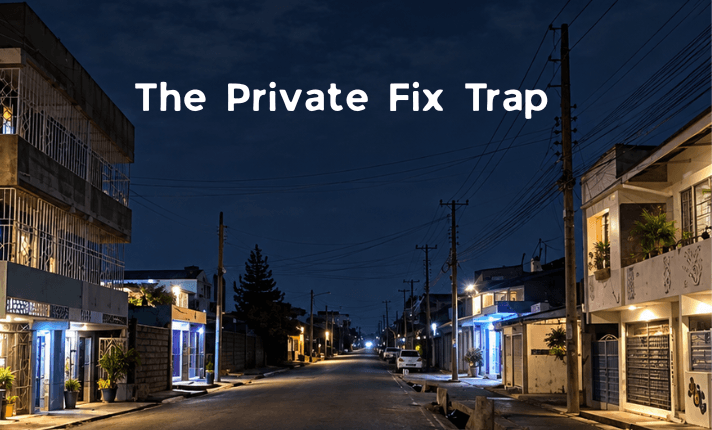

Walk down any street in Lagos at 8 p.m. when the power goes out. Within a minute, the same sound rises from every compound: ten generators, ten fuel bills, ten families who each solved the same problem alone.
The problem is still there tomorrow.
The Logic Is Sound
Nobody buying a generator is making a mistake. If your children need light to study and your fridge holds a week of food, you cannot wait for a policy meeting. The same goes for the borehole, the inverter, the private security guard, and the private school. These are practical decisions made by people who are tired of waiting.
That is exactly why the trap is hard to see. Every private fix is smart. The damage only shows up when you add them together.
What Quietly Disappears
A public system improves when the people who depend on it complain, and when the most influential people complain loudest. A manager, a lawyer, a business owner, a journalist: these are the people who know whom to call and who gets listened to.
But once they have a generator, a borehole, and a private school, they no longer need the public version. Their complaints stop. Not because the problem is solved, but because it no longer touches them.
Who is left? The families who cannot afford the private fix. They stay behind with the weakest voice and the worst version of the service.
There is also a cost that rarely gets said out loud. We pay taxes, tariffs, and fees for services that do not work. Then we pay again for the private replacement.
And the private version is often the more expensive one per person. Ten households each running a petrol generator spend far more in total than one well-run shared power source would cost them. We are not just stuck with the problem. We are paying a premium to live with it.
So What Can Actually Change?
Not "stop buying generators." That advice is useless to someone sitting in the dark.
What works is moving the private fix one step toward the shared one. A few examples:
- Shared power: A street pulls money for one solar-and-battery system instead of ten petrol generators. Costs drop, noise drops, and the group now has something to manage together.
- Organised estates: Residents' associations that write to the utility company with one voice, with dates and records of outages, are harder to ignore than ten angry individuals.
- Funded repairs with accountability: If a community pays to fix a road or a transformer, it can also demand receipts, publish the cost, and invite the local authority to match it. Paying alone is charity. Paying together while keeping score is pressure.
None of this replaces a working public system. But it rebuilds something the private fix destroys: people who act together and expect results.
Try one thing this month. Knock on the doors of three neighbours. Ask one simple question: "How much do you spend on power each month?"
Add up the answers. Most streets are shocked by the total. That number is the start of every collective solution, because it shows what the problem really costs, and what the group could do with that money instead.
A society is not judged by how well each person protects themselves. Anyone with enough money can do that. It is judged by how rarely they have to.