

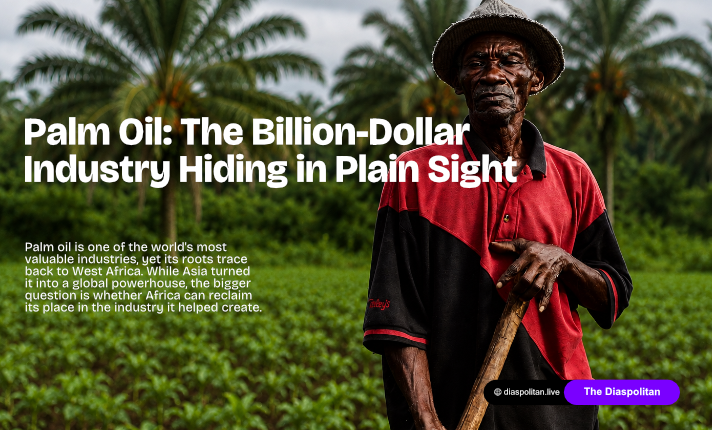
When most people think about billion-dollar industries, they picture oil rigs, microchips, or tech startups. Palm oil never makes the list. It should.
There's a good chance you've used palm oil today without even realizing it. It's in foods, cosmetics, soaps, shampoos, candles, and even some biofuels. In fact, palm oil is the world's most widely used vegetable oil, making it one of the most valuable agricultural commodities on the planet. But this global industry has deep African roots.
The oil palm (Elaeis guineensis) is native to West Africa. Long before palm oil became an international commodity, communities across present-day Nigeria, Ghana, Cameroon, and other parts of the region were cultivating and processing it for cooking, medicine, and trade. Archaeological evidence even suggests palm oil was used in West Africa thousands of years ago. In many ways, Africa didn't just discover palm oil. It introduced it to the world.
So why do many people associate palm oil with Malaysia instead? The answer is history and scale.
During the colonial era, oil palm seedlings were taken from West Africa to Southeast Asia. Malaysia and Indonesia invested heavily in large-scale plantations, research, processing, and exports. Today, those two countries produce roughly 85% of the world's palm oil, turning it into a multi-billion-dollar export industry. Meanwhile, many African countries, despite being the crop's original home, produce far less and often struggle to compete globally. It's a reminder that having the resource isn't always enough. The real wealth often comes from building the systems around it.
Now, here's a claim that often gets repeated: palm oil is more expensive than crude oil.
The truth is a little more complicated. Palm oil and crude oil are traded in completely different markets, so comparing their prices isn't straightforward. There have been periods when palm oil has sold for more per tonne than crude oil on an equivalent weight basis, especially when vegetable oil supplies are tight or energy prices fall. At other times, crude oil has been worth more. In other words, it depends on market conditions. The comparison makes for an interesting headline, but it isn't a permanent rule.
What isn't up for debate is palm oil's economic importance. The industry generates hundreds of billions of dollars in economic activity across farming, manufacturing, logistics, retail, and exports. Millions of smallholder farmers depend on it for their livelihoods. For countries that have developed efficient production and processing systems, palm oil has become a major source of national income. Of course, the story isn't entirely positive. Palm oil has also become one of the world's most controversial crops. Large-scale plantation expansion has contributed to deforestation, habitat loss, and carbon emissions in some regions, particularly in Southeast Asia. Environmental groups have pushed for more sustainable farming practices, while producers argue that palm oil actually yields far more oil per hectare than competing crops like soybean or sunflower. If the world replaced palm oil entirely, we would likely need much more farmland to produce the same amount of vegetable oil.
For Africa, the challenge isn't simply whether to produce it, but how to turn it into a major sources of national income. The continent still has suitable land, generations of knowledge, and a growing domestic market. If investments focus not only on growing oil palm but also on processing, refining, branding, and exporting higher-value products, palm oil could once again become one of Africa's strongest agricultural success stories. Perhaps the biggest lesson isn't about palm oil itself. It's about value.
Resources create opportunities, but industries create wealth. Africa gave the world one of its most important crops. Others built empires around it. The question now is whether the continent can write the next chapter of that story. And maybe that's the opinion worth leaving on the table: should Africa focus less on exporting raw resources and more on owning the industries built around them?