
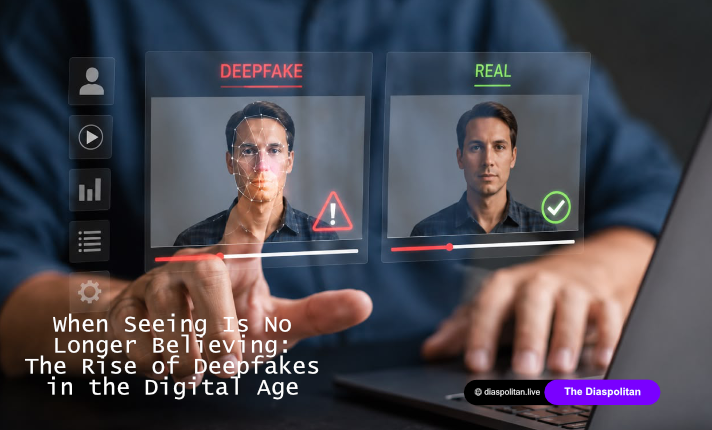
There was a time when photos and videos were proof. Seeing something with your own eyes often settled debates, ended speculation, and reinforced trust in what was being shared. Today, that certainty is beginning to fade. Welcome to the age of deepfakes.
If you've spent any time online recently, you've probably come across a video that made you pause. Perhaps it showed a celebrity saying something completely unexpected, a public figure making a controversial statement, or someone speaking a language they had never learned. At first glance, it all seems remarkably authentic until you discover it was generated or altered using artificial intelligence. It's fascinating. And it’s slightly unsettling.
Deepfakes are created using AI to generate or manipulate images, audio, and videos that closely resemble real people. Technology has advanced at an astonishing pace. What once looked clumsy and obviously fake can now appear incredibly convincing, especially when viewed on a smartphone screen where small imperfections are easy to miss.
Of course, not every deepfake is created with harmful intent.
The same technology has found legitimate uses in filmmaking, education, accessibility, and entertainment. Filmmakers can recreate historical scenes, educators can bring historical figures to life for learning experiences, and translation technologies can make it appear as though someone is speaking another language while preserving their facial expressions. In the right hands, deepfake technology has the potential to become a powerful creative tool.
Like many technological breakthroughs, the concern isn't necessarily the technology itself. It's how it's used. One of the biggest concerns is misinformation.
Imagine a convincing video appearing online showing a well-known individual making an outrageous statement. Even if the video is debunked within hours, it may already have reached millions of people, been shared across countless platforms, and sparked conversations around the world. The correction often struggles to travel as far or as fast as the original claim. This isn't an entirely new challenge. Misleading headlines, edited photographs, and manipulated videos have existed for years. What has changed is the realism of AI-generated content and the speed at which it spreads.
Another growing concern is fraud.
Around the world, there have been reports of scammers using AI-generated voices to imitate family members, company executives, or trusted colleagues. A convincing voice message or phone call can ask for an urgent money transfer or sensitive information. If it sounds exactly like someone you know, it’s hard to question. This has prompted cybersecurity experts to encourage people to verify unusual requests through another trusted method before taking action.
Fortunately, this doesn't mean people are powerless. In fact, the rise of deepfakes may be encouraging one of the most valuable skills in the digital age: healthy skepticism. That doesn't mean assuming everything online is fake or becoming suspicious of every video you encounter. It simply means taking a moment before reacting or sharing content that seems unusually dramatic, emotional, or difficult to believe.
A few simple questions can make a significant difference. Who originally shared the content? Has it been reported by multiple credible sources? Is there evidence that the media has been manipulated? Sometimes, spending just a minute verifying a piece of content can prevent misinformation from spreading much further.
Technology companies are also investing in tools designed to detect AI-generated media, while researchers continue exploring methods such as digital watermarking and authentication systems. Whether these solutions will always keep pace with increasingly sophisticated AI remains uncertain, but efforts to improve detection continue to evolve.
Perhaps the biggest lesson isn't about artificial intelligence at all. It's about trust. For decades, society has relied on photographs and videos as reliable evidence of reality. As AI becomes more capable, simply seeing something may no longer be enough. Increasingly, understanding where content came from, who created it, and why it was shared may become just as important as the content itself. That shift feels uncomfortable, but it also encourages more thoughtful consumption of information.
If deepfakes inspire people to slow down, question extraordinary claims, and seek reliable sources before forming conclusions, they may unintentionally strengthen one of the most important skills of the modern era: critical thinking.
Artificial intelligence will continue to produce technologies that surprise, inspire, and challenge us. Deepfakes are one example of how innovation often arrives carrying both remarkable possibilities and significant responsibilities. In a world where almost anything can be created convincingly, perhaps the most valuable habit we can develop isn't believing everything we see, but learning when to pause and ask questions before we do.