
If for some reason, I flip the wrong coin,
Or drown in the wrong sea with time portals,
And find myself back in 1914.
How relevant would I be?
Would I remember to warn the Ibos about invasion?
Would I remember to tell the government that there is liquid gold in Niger Delta?
That we should make preparations to drill and own
So we do not sign it all away to foreign companies?
Or would I be stuck because I can’t Open AI?
To check where the crude oil was first found or who took them from us?
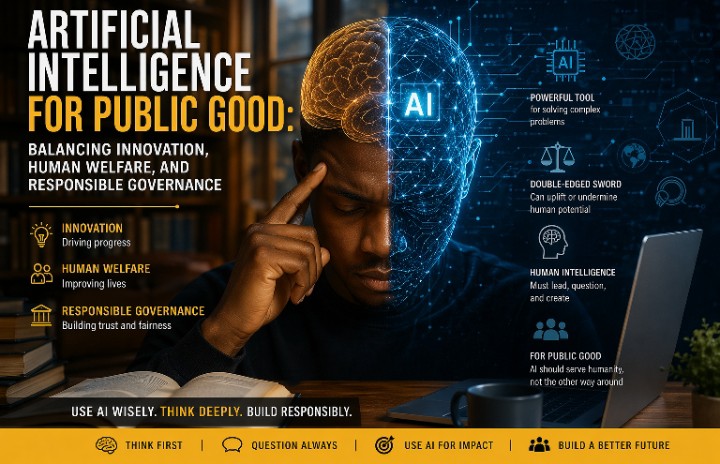
Artificial intelligence cannot replace human intelligence, but it can dull it. This is not to say AI has no merits. In fact, the merits are numerous. It has smoothened automation, made data procession faster, made knowledge accessible, spiked innovation, improved human welfare and balanced responsible governance.
Statistics from PwC Reports show that 64% of African workers used AI tools in 2025, higher than global average (54%). Telecom giant MTN achieved 5–7% reduction in operational costs using AI, R2 billion ($100M+) annual savings from AI-driven efficiency and 15% improvement in network performance.
This is owed majorly to the fact that AI in customer service has moved from optional to almost unavoidable. 67% of businesses already use AI chatbots, 73% of Fortune 500 companies rely on AI agents, Over 70% of service organizations have deployed or piloted AI, and 98% of contact centers use AI in some form.
A thousand years ago, business was not this technical because there were fewer people to serve. But with the sporadic population growth in the previous centuries, automation has become a necessity in business management and customer service. A business like MTN that services over 300 million people can no longer rely on the traditional system of hiring customer service agents to address the complaints of their customer base. The introduction of AI has definitely more good than harm for the public at large.
However, artificial intelligence is a double edged sword with disadvantages as sharp as the advantages offered. Even though it cannot replace human intelligence, it has made humans less intelligent. How? By taking the burden of thinking from humans, the brain becomes underused – rusted in fact because the brain was designed to be in use.
Now what happens when we do not use our brains as often as we used to?
When you stop using your brain as actively as before, it gradually becomes less efficient due to Neuroplasticity—the brain strengthens what it uses and weakens what it doesn’t. Over time, this can lead to slower thinking, weaker memory, and reduced focus, especially as people rely more on external tools in a process known as Cognitive Offloading. You may find it harder to concentrate, solve problems quickly, or retain information because the brain is no longer being challenged at the same level.
In the long term, consistently low mental stimulation is linked to a higher risk of cognitive decline, including conditions like Dementia and Alzheimer’s disease. While technology and AI are not inherently harmful, over-reliance on them can reduce critical thinking and mental independence if not balanced with active engagement. Ultimately, the brain adapts to the level of effort required of it—so reduced use doesn’t destroy it, but it does make it less sharp and less resilient over time.
Too much accessible knowledge dulls the quest for knowledge. In the negative regard, we can say artificial knowledge is shutting off certain functionalities of our brains. Gone are the days when we had to memorise periodic tables, historic dates and events, formulas. Now all we need to do is ask Ai, use it for the text we need it for and alt+delete from our brains like it was never there.
This is cool for brains that have been drilled through processes, but for the coming generation it is a bigger problem. Research on digital-native cohorts shows increased “cognitive offloading” (relying on phones/AI for memory and thinking tasks), which can reduce independent recall performance over time.
Artificial intelligence has replaced process with automation, depriving brains of getting better and faster at things. Practice makes perfection but AI takes away the need for practice and replaces it with automation. I say that is a problem.
What do we do then? We need to learn to wield AI as a weapon, keeping in mind that it is double edged and it can cut both ways. One, we must think first, then ask AI. Before you ask AI anything, form your own answer (even if it is rough), then compare. This forces active engagement instead of passive consumption. It directly strengthens Active Recall, which is one of the most powerful learning mechanisms.
Two, Argue With AI (Don’t Just Agree). Use AI as an opponent, not an oracle. Challenge its assumptions. Ask for counterarguments. This builds Critical Thinking – the exact skill most at risk in an AI-heavy environment.
Three, Do “Mental Reps” Without Assistance. Pick tasks where you deliberately avoid AI: Mental math, writing from scratch and explaining concepts in your own words. This builds cognitive endurance – like going to the gym without machines doing the lift for you.
Finally, Use AI for Feedback, Not Replacement.
If these steps are followed, artificial intelligence can be harvested for public good, as we balance Innovation, improve human welfare, and steward responsible governance.