
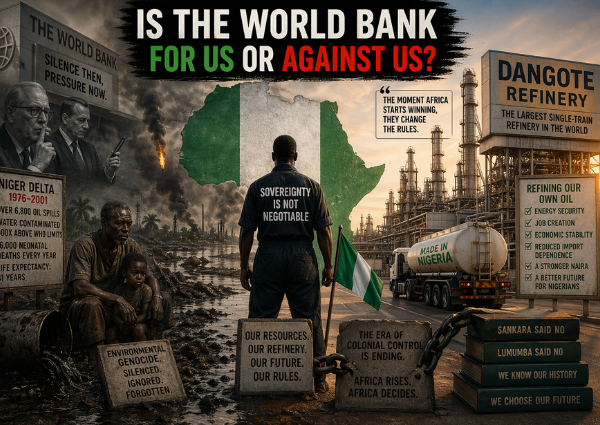
For decades, the narrative of Nigerian energy was one of tragic irony: a nation floating on a sea of crude oil, yet queuing for hours at filling stations for expensive, imported fuel. The recent operationalization of the Dangote Refinery, the largest single-train refinery in the world, was supposed to be the definitive “checkmate” against this colonial-era paradox. Yet, as the smoke clears from the first batches of locally refined petrol, a familiar ghost has re-emerged from the halls of Washington D.C.
The World Bank’s recent recommendation that Nigeria reopen its market to foreign fuel imports is being framed as a pursuit of “market efficiency” and “price competition.” But to many observers, it looks less like economics and more like the geopolitical equivalent of moving the goalposts the moment Africa scores a goal.
To understand the skepticism surrounding the World Bank’s “concern” for the Nigerian consumer, one must look at the geography of their silence. Between 1976 and 2001, the Niger Delta was subjected to over 6,800 oil spills. While European oil majors extracted billions in wealth, they left behind a landscape described by experts as an “environmental genocide.” Groundwater contamination reached levels 900 times above WHO safety limits. Oil spills in the Niger Delta are connected to 16,000 neonatal deaths every year and life expectancy in these regions plummeted to a staggering 41 years.
Where were the “emergency reports” then? Where were the stringent conditions imposed on European governments to ensure their corporations adhered to basic human rights? The silence was deafening. It suggests a grim reality: the Bretton Woods institutions (the World Bank and the IMF) have historically been far more concerned with the flow of capital than the flow of blood in the Delta.
The critique of these institutions isn’t just emotional; it is structural. The math of global governance is still written in the ink of 1944.
By tradition, the President of the World Bank is always an American. The Managing Director of the IMF is always a European. A British citizen’s vote within the IMF carries 23 times the weight of a Nigerian’s. So when the World Bank speaks of “restoring competition,” it is speaking from a position of inherited colonial authority. For a century, the rules of global trade were designed to keep Africa as a provider of raw materials and a consumer of finished goods. A Nigerian-owned refinery that processes Nigerian crude to sell to Nigerian people disrupts this “extraction-consumption” loop. It threatens the import dominance that European refineries have enjoyed for decades.
History in Africa is often written in the blood of those who said “no.” From Thomas Sankara, who rejected the debt-trap of the IMF, to Patrice Lumumba, who sought to keep Congo’s mineral wealth for the Congolese, the penalty for asserting economic sovereignty has often been existential.
The World Bank’s recent report, which was tellingly retracted shortly after a public pushback from Aliko Dangote, signals a continuation of this pressure. By demanding “competition” just as a domestic industry finds its feet, these institutions are effectively asking Nigeria to abandon the “infant industry” protections that the United States, Great Britain, and China all used to build their own industrial empires.
Ultimately, this is a question of moral authority. Can institutions controlled by the very nations that built their wealth on African labor and resources truly claim to be “partners” in African development?
Every nation has a sovereign right to determine the fate of its natural resources. If Nigeria chooses to prioritize domestic refining to stabilize its currency and ensure energy security, that is a sovereign prerogative. The “market” is not a god to be worshipped at the expense of national stability.
The era of taking “expert advice” from the architects of the status quo is ending. If the World Bank and the IMF wish to remain relevant in a multipolar world, they must move beyond their colonial character. Until then, Africa must recognize them for what they have frequently been: not the engines of growth, but the obstacles to it.
The refinery is more than just a collection of steel pipes and cooling towers. It is a declaration of independence. And as history shows, independence is never given, it is defended.