
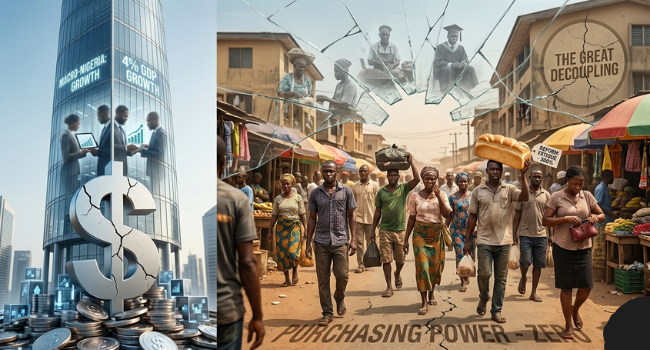
If you’ve been watching the news lately, you might have heard that Nigeria’s economy is finally “recovering.” The experts in Abuja and Lagos are pointing to spreadsheets that show a 4% growth rate. They talk about the Naira finally standing still after years of falling, and they celebrate big companies moving back into the country.
On paper, Nigeria looks like a student who just moved from a failing grade to a solid “B.” But if you ask the mother buying ingredients for soup or the graduate looking for a job, they’ll tell you it feels like they’re still failing.
This is what we call the “Stabilization Paradox.” It’s a fancy way of saying the country is getting better, but the people are getting tired.
Think of the Nigerian economy like a giant ship. The “Macro” view (the one the government sees) is the engine room. They’ve finally fixed the leaks, the engine is humming, and the ship is technically moving forward at 4 knots.
However, the “Micro” view (where you live) is the deck of the ship. Up there, the sun is scorching, there’s no food, and the passengers are exhausted from years of baling out water. Even though the ship is moving, the people on deck don’t feel “faster”, they just feel tired.
The growth we are seeing in 2026 is happening in “big” industries: oil, big banks, and tech companies. These businesses make a lot of money, but they don’t hire millions of people. So, the country’s bank account grows, but your neighborhood’s economy stays quiet.
The biggest reason 4% growth feels like 0% is the cost of living. In 2024 and 2025, Nigeria went through “economic surgery.” The government removed fuel subsidies and changed how the Naira was valued. It was meant to save the country from bankruptcy, and it worked, but it also sent prices through the roof.
By 2026, inflation has finally slowed down. This means prices aren’t jumping up every single week like they used to. But prices didn’t come back down. If a bag of rice jumped from ₦30,000 to ₦70,000 during the crisis, “stability” in 2026 just means it’s still ₦70,000. For someone whose salary didn’t triple, that isn’t “good news.” It’s just a permanent struggle.
We are seeing two different Nigerians emerge:
The Connected Few: These are people working for global companies or in high-tech sectors. Their pay is high, they travel, and for them, Nigeria’s “stability” is a dream come true.
The Majority: These are the traders, the teachers, and the small business owners. They rely on the “informal economy.” Because the average person has less money to spend, these businesses are struggling to survive, even as the “national” economy grows.
The government has succeeded in fixing the “math” of Nigeria. The currency is stable, and the numbers are up. But math doesn’t feed a family.
For the growth of 2026 to actually matter, it has to move from the skyscrapers of Lagos into the kitchens of everyday Nigerians. Until 4% growth means cheaper transport, more jobs for graduates, and lower food prices, most Nigerians will continue to ask: “If the economy is growing, why is my pocket shrinking?”